DISCOVERY
The opportunity
Competitive research revealed a broken pattern: on platforms like LinkedIn and Behance, users spent more time searching and filtering than actually collaborating.
This led us to ask …
What if the platform did the matchmaking?
User research
We interviewed emerging and established designers to understand what's blocking creative collaboration.
"I'd love help. But I don't have time to search and 'teach.'"
(Senior designer)"It's hard to prove what I can do without someone trusting me first."
(Junior designer)"I'd love help. But I don't have time to search and 'teach.'"
(Senior designer)"It's hard to prove what I can do without someone trusting me first."
(Junior designer)
The insight:
Both groups wanted to work together, but were held back by trust gaps, unclear roles, and mentorship burnout. From that point, we designed CTRL+Z with AI at the core. Not as a gimmick, but as infrastructure that evaluates skills, availability, and project goals to generate ranked matches.
Problem definition
Three core tensions emerged:
Access:
Juniors lacked visible entry points. Seniors struggled to find trusted collaborators without heavy vetting.Clarity:
Ambiguous roles created anxiety. Users needed clear cues for progress, ownership, and expectations.Feedback:
Juniors wanted actionable input. Seniors wanted to support growth without draining their time and energy.
Journey Map:
Discovery
Laura discovers the Collab Hub.
Mark posts a project brief.
Matching & Onboarding
AI matches based on skills and goals.
Mark shortlists and selects a junior.
Collaboration
Laura receives structured deliverables and starts working.
Mark reviews output at his convenience.
Reflection
Mark leaves quick feedback.
Laura reflects and documents the project for her portfolio.
Market validation
TAM: 30M+ global creative roles tied to growth and collaboration
SAM: 8.7M creatives in Europe in project-based contexts
SOM: 800K+ professionals and juniors actively seeking mentorship, portfolio reviews, or collaborators
Design direction
Junior designers …
need real-world, low-barrier projects to gain experience and grow their portfolios.
Senior designers …
need efficient ways to delegate creative tasks, without the time drain of traditional mentorship.
From our research, we identified what users actually need:
How might we help juniors build confidence through real work?
How might we reduce effort for seniors to delegate tasks?
How might we make experience more accessible?
DESIGN
Strategic pivot
Early concept work explored mentorship features, forums, and events. But value mapping revealed these were high-effort, low-return.
We didn't need to replicate mentorship,
we needed to replace it with proof-of-work.
Cut
Mentorship matching, discussion forums, networking events
Prioritized
AI-based project matching, task-based collaboration hub, lightweight feedback tools
Ideation & prioritization
Through rapid sketching and prioritization frameworks, four themes emerged:
Smart matching:
AI recommends collaborators based on skills, availability, and goals, not just portfolios.Project flows:
Clear pathways for creating, applying, and managing projects, tailored by role.Role-based dashboards:
Seniors and juniors see different actions and statuses based on their involvement.Feedback that fits:
Lightweight feedback tied to tasks. No pressure, just progress.
We mapped features into three value levels:
Transformational
Career momentum, fair access, async collaboration
Functional
AI matching, task dashboard, feedback system
Baseline
Clear roles, transparency, no tool overload
→ This ensured every design decision solved a real user need.
Early testing & iteration
We tested lo-fi wireframes with both user groups. Three critical issues surfaced:
Issue 1
"What does involvement mean?"
Added tooltips, clearer labels, and custom input fields
Issue 2
"Projects are everywhere. What's what?"
Simplified navigation, cleaned preview cards, reorganized dashboards
Issue 3
"Can I revise my feedback?"
Added progressive task states and editable feedback loops
Design system
Our visual language reflects the platform's core promise:
clarity without clutter.

Calm by Default
Grayscale system highlights work, not interface

Commitment Through Contrast
Color appears only when users
take action
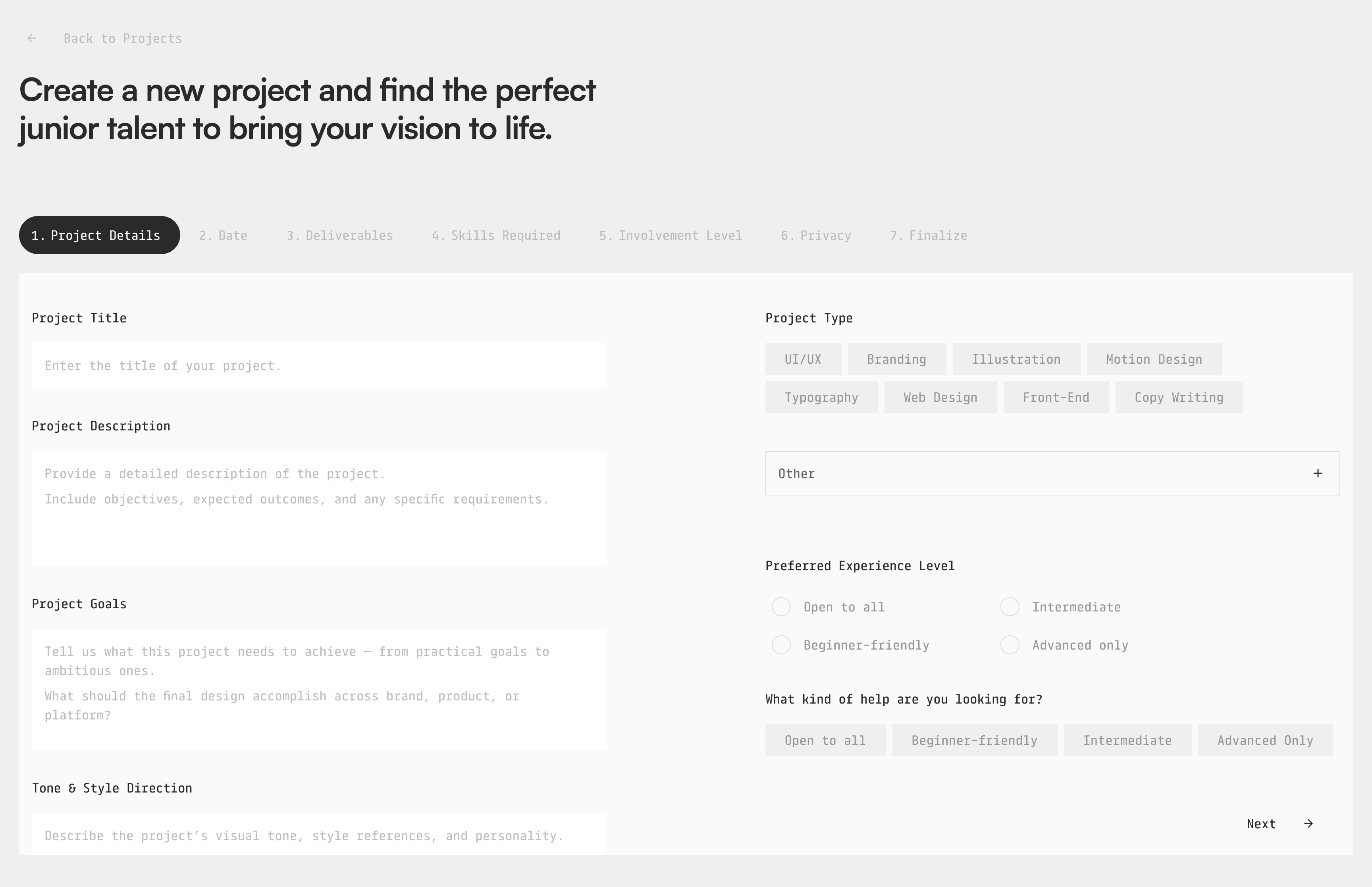
Clarity Through Structure
Hierarchy, visual tone, and role-based content create confidence
Final Designs
Junior Designer Flow:
Browse AI-matched projects
Apply with portfolio + custom message
Collaborate via task dashboard
Receive structured feedback
Senior Designer Flow:
Create project with scope, timeline, skills needed
Review AI-ranked applicants
Assign tasks and provide feedback
Manage multiple collaborations
Key Features
AI match transparency (shows why matches are 92%, 85%, etc.)
Task-based project structure
Feedback states (draft, submitted, revision)
Progress indicators
Notification system
"Create a Project"
Senior Designer Profile
"Apply to a Project"
Junior Designer Profile
"Project Management"
Senior Designer Profile
"Project Management"
Junior Designer Profile
IMPACT
Approach
Who did we test with?
Emerging creatives:
Tested AI-match flows, task applications, and feedback clarity.Industry pros:
Tested project creation, collaborator vetting, and async workflows.
Key iterations

“What does involvement mean?”
Tooltips, clearer labels, and custom input fields clarified project expectations.
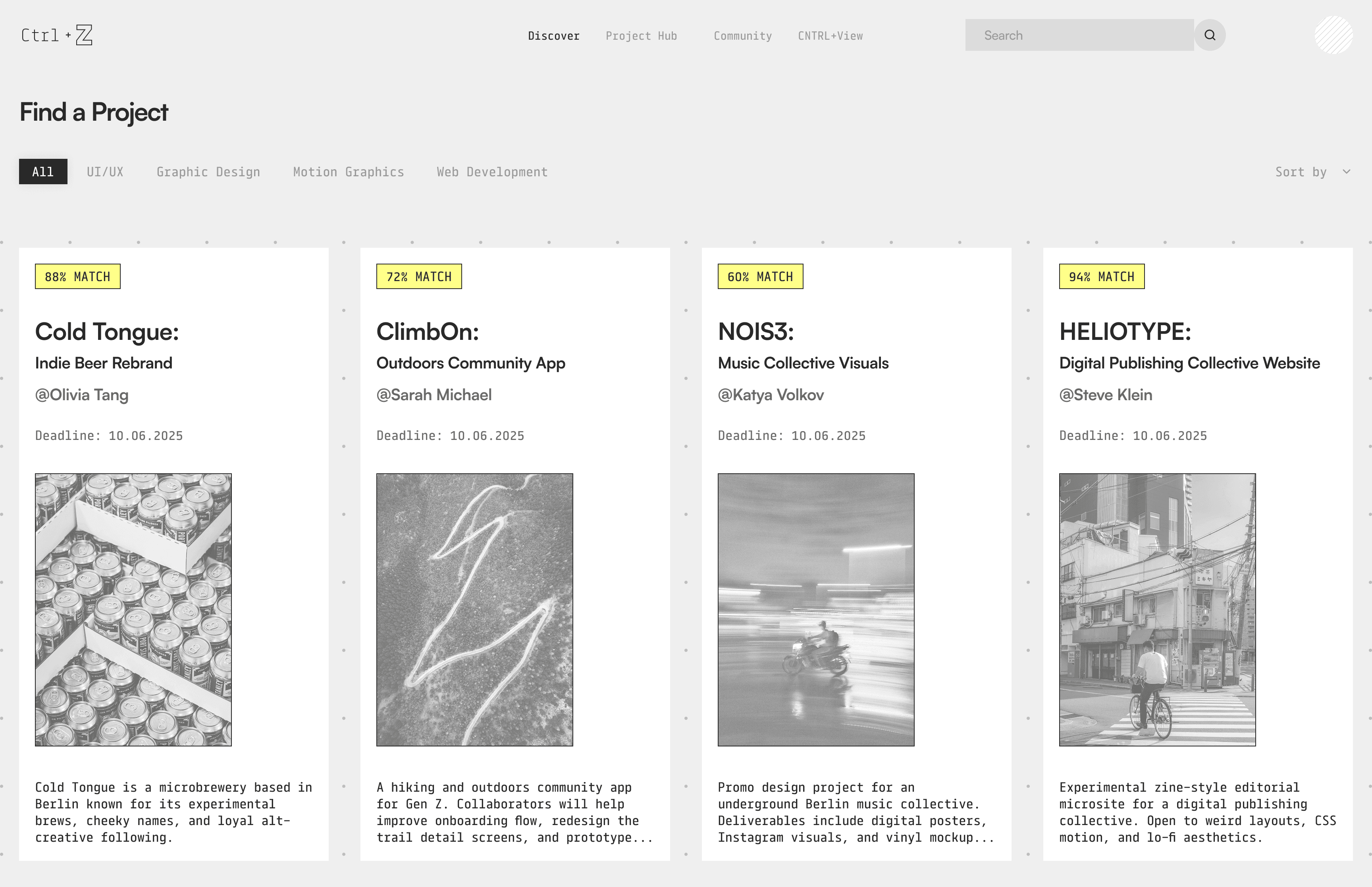
“Projects are everywhere. What’s what?”
Navigation was cleaned up, preview cards simplified, and dashboards reorganized.

“Can I revise my feedback?”
We added progressive task states and editable feedback loops.
“Why is this match 92%?”
Match breakdowns were added for transparency.
Testing results
We validated the final prototype with 12 users across both groups.
What we measured:
Task completion rates
Clarity of match reasoning
Confidence in applying/posting projects
Feedback loop satisfaction
Key Findings:
Juniors felt empowered to apply, deliver, and grow their portfolios.
Seniors felt in control, not overwhelmed by collaboration requests.
Everyone understood the system and trusted the AI recommendations.
92% said they would use this over existing platforms.
"This is the first platform that actually respects my time while still letting me support new designers."
"I finally feel like I can get real experience without begging for opportunities."